Notes on a few plants
21 avril 2026
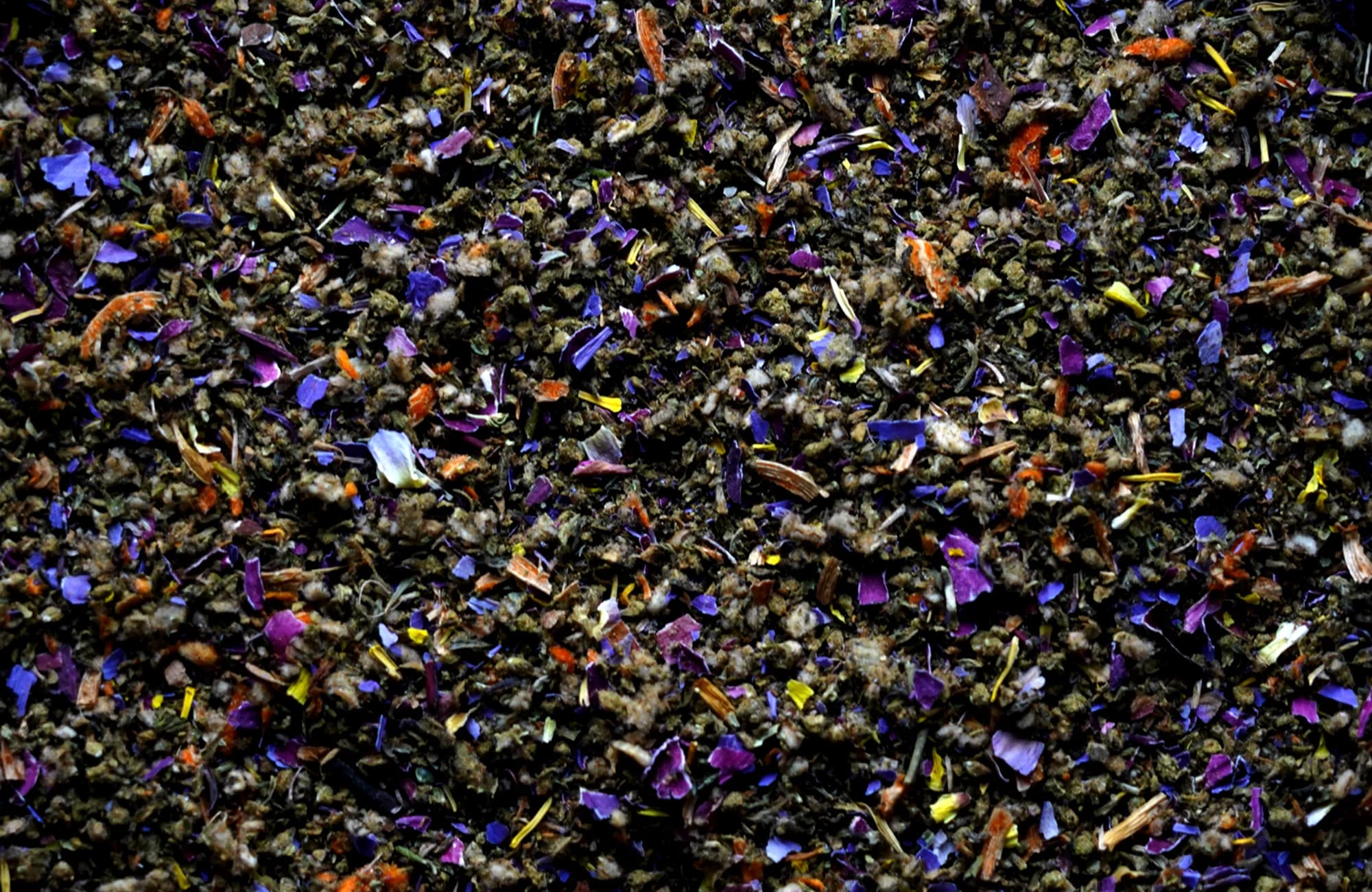
When you work with the same plants over and over again, you gradually develop a kind of familiarity with them. You learn which ones naturally stay in the background, which ones immediately take over a composition, which vary noticeably from one batch to another and which seem to need another plant beside them before their character really makes sense.
This notebook is not a medical herbal guide and does not attempt to list therapeutic properties. These are simply observations drawn from our blending work at Shiva Blends: how we look at plants, their textures, their aromas and the place they can occupy within a recipe.
Mullein
Mullein is one of the plants we often return to when a composition needs a light, relatively neutral foundation. Its value lies largely in its discretion: it can bring material and structure without immediately pushing the blend in a strong aromatic direction.
We particularly appreciate it in recipes where other plants need room to express themselves without competing with an overly fragrant base. It is more of a structural plant than a star ingredient, which is precisely what makes it so useful in blending.
Raspberry leaf
Raspberry leaf has a more distinctly leafy character. It brings a fuller vegetal presence and works well when we want a base that feels simple, natural and grounded.
Combined with mullein, it can form the starting point for relatively restrained recipes, leaving room for a more expressive plant to be introduced later. It is a good example of the way we tend to work: the foundation does not need to be spectacular in order to be important.
Damiana
Damiana has far more personality. Its profile is warm, herbaceous and aromatic, and it becomes easy to recognise once its proportion begins to rise within a recipe.
One of the things we enjoy most is seeing how much a small shift in proportion can change the whole blend. Too little and damiana may disappear behind the base. Too much and it can quickly dominate. Somewhere between the two is often a more interesting balance, where it gives the recipe depth without preventing the other plants from being noticed.
Blue lotus
Blue lotus already carries a very distinctive world around it before it ever reaches a recipe. Its violet petals, golden centre and long presence in ancient Egyptian imagery have helped surround the plant with a particularly rich cultural imagination.
In our blends, however, we prefer to treat it as a plant rather than as a mystical symbol onto which every possible claim should be projected. Its interest lies in its botanical character, in the history associated with it and in the way it can subtly alter the personality of an assembly.
We also find it more interesting when it does not attempt to dominate the entire composition. Used with restraint, it often sits much more naturally within the blend.
Wild Dagga
Wild Dagga is immediately recognisable thanks to its vivid orange flowers. The plant has an almost flamboyant visual character, while its botanical profile requires a little more experimentation to find the right place within a recipe.
We mainly use it when a composition needs something more distinctive, capable of setting it apart without necessarily becoming the dominant aroma. It is a good example of an ingredient that can contribute strongly to the identity of a blend without being the first plant you notice.
St John's wort
St John's wort has a more discreet presence in our compositions. Its small yellow flowers naturally evoke summer meadows and traditional herbariums, but within a recipe its role is mainly about nuance and the overall balance of the blend.
As with any plant known to have specific precautions or interactions, working with it also requires particular attention to information and traceability. A plant's botanical character should never make us forget that it has its own chemical composition.
Mint
Mint is a useful lesson in restraint for anyone beginning to blend plants. It can contribute an enormous amount with very little material. Its freshness is immediately recognisable, and small adjustments are often enough to completely change the profile of a recipe.
It regularly reminds us that a plant does not need to occupy a large percentage of a blend in order to play an essential role. In some recipes it works more like a brushstroke than a background colour.
Rose, lavender and other aromatic flowers
Flowers generally reward a light hand. Rose can bring a delicate, rounded nuance, while lavender has a much more immediate aromatic intensity. In both cases, restraint is often where things become interesting.
A small amount may be enough to introduce the detail that the recipe was missing. Too much, on the other hand, can easily obscure the structure created by the other plants. This is one of the reasons we never think only in terms of ingredients, but in terms of proportions.
A plant never really exists alone
This is probably the most fascinating part of blending. The character of a plant changes depending on what surrounds it. Damiana feels different over a very neutral base. A flower becomes much more noticeable when placed among discreet leaves. A small touch of mint can make a familiar recipe feel entirely new.
This is also why a formula never completely describes a blend. You have to smell it, look at the material, compare several versions and sometimes leave a composition alone for a while before you understand what is working and what still needs adjusting.
In the end, this is probably why we continue to compose. A handful of fairly simple plants can become something that did not really exist in any of them individually. That small, very tangible form of botanical alchemy is what still keeps us curious.
These notes describe our work with plants and their botanical or aromatic characteristics. They are not therapeutic claims or health advice. Some plants may have contraindications or interact with medication.
To carry on:
Building a botanical blend · find the blend that suits you · Inside the workshop